Architecture
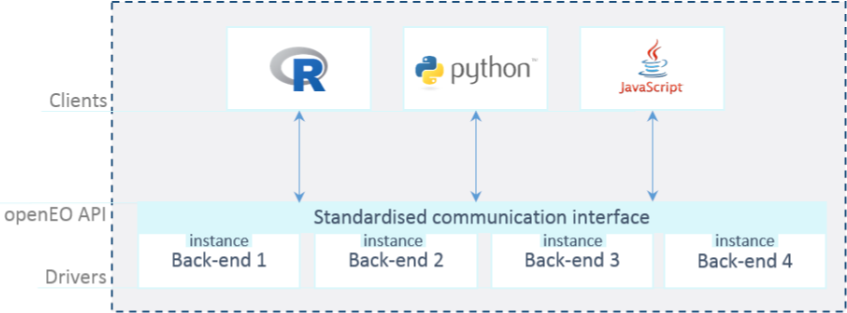
The openEO API defines a language for how clients communicate to back-ends in order to analyze large Earth observation datasets. The API will be implemented by drivers for specific back-ends. Some first architecture considerations are listed below.
- The openEO API is a contract between clients and back-ends that describes the communication only
- Each back-end runs its own API instance including the specific back-end driver. There is no API instance that runs more than one driver.
- Clients in R, Python, and JavaScript connect directly to the back-ends and communicate with the back-ends over HTTPS according to the openEO API specification.
- API instances can run on back-end servers or additional intermediate layers, which then communicate to back-ends in a back-end specific way.
- Back-ends may add functionality and extend the API wherever there is need.
- There will be a central back-end registry service (openEO Hub), to allow users to search for back-ends with specific functionality and or data.
- The openEO API may define profiles in order to group specific functionality.
Microservices
To simplify and structure the development, the API is divided into a few microservices.
| Microservice | Description |
|---|---|
| Capabilities | This microservice reports on the capabilities of the back-end, i.e. which API endpoints are implemented, which authentication methods are supported, and whether and how UDFs can be executed at the back-end. |
| EO Data Discovery | Describes which collections are available at the back-end. |
| Process Discovery | Provides services to find out which processes a back-end provides, i.e., what users can do with the available data. |
| Data Processing | Organizes and manages data processing on the back-end, either as synchronous on-demand computation or batch jobs. |
| File Storage | Organizes and manages user-uploaded files. |
| User-Defined Processes | Organizes and manages user-defined processes (process graphs). |
| Secondary Services | External web services to access data and job results such as a OGC WMTS service. |
| Account Management | User management, accounting and authentication. |
| UDF Runtime | Execution of user-defined functions, not part of the Core API. See the UDF documentation for more information. |